Hiding in plain sight: My life of masking, tics and Tourette Syndrome
As a caveat- this post involves a frank exploration of Tourette Syndrome, a more serious and personal subject than I usually write about, but it’s one I feel very strongly about. For anyone expecting the usual light and frolicking science and soil fun, don’t worry, the usual, bouncy soil animal content will resume next time.
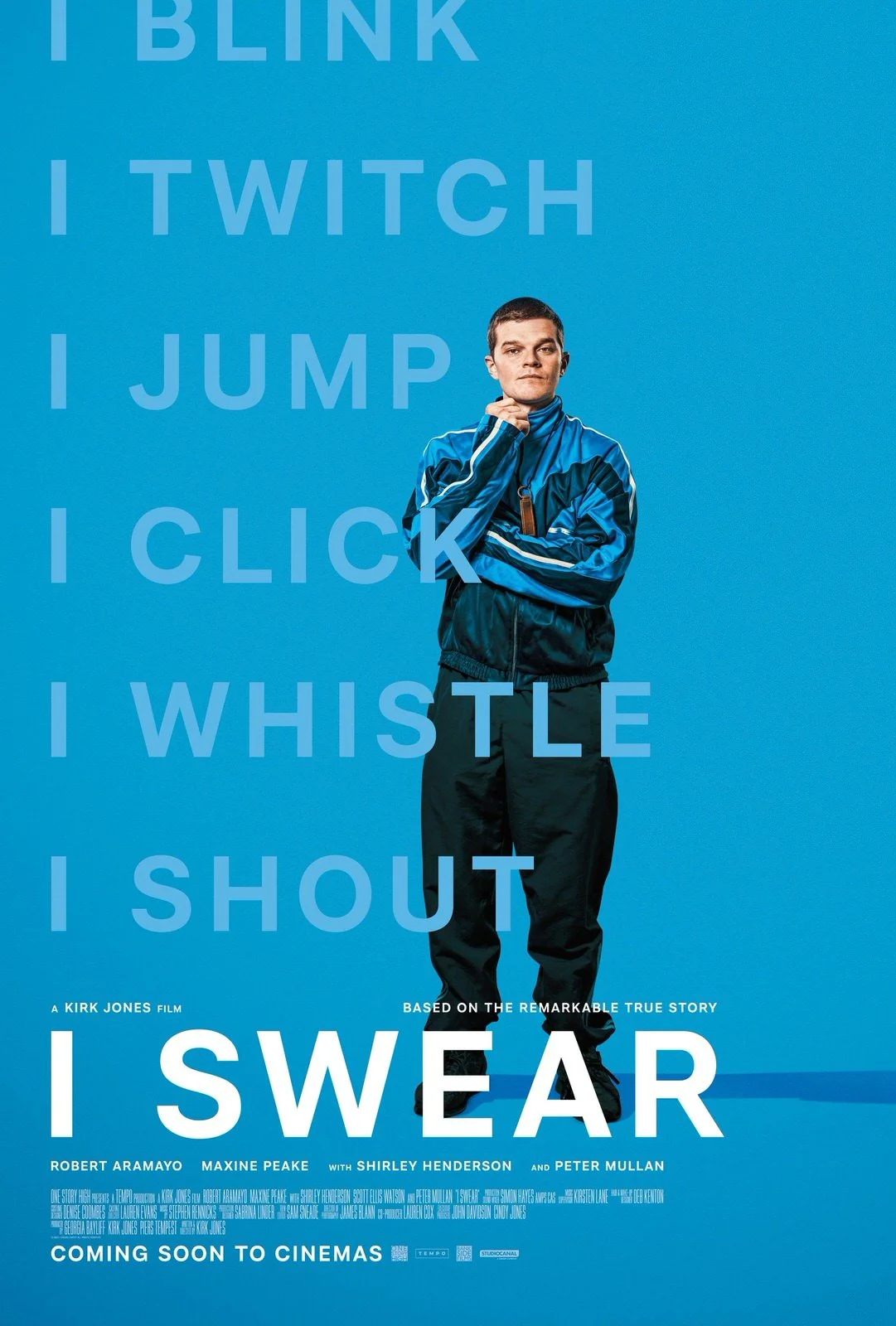
The film poster for I Swear

John Davidson MBE, advocate for Tourette Syndrome
The release of the film, I Swear at the end of 2025 stirred up a lot of emotions and memories for me, eventually leading me to writing this post. The film (and book) explores the real-life story of John Davidson, a man with extreme Tourette Syndrome and his journey from childhood difficulties, isolation and ignorance to a place of better understanding, compassion and love and his eventual receiving of an MBE for his advocacy of Tourette Syndrome. The film is undeniably wonderful (I’m yet to read the book, written by Davidson himself) but was occasionally pretty hard for me to watch due to the many similarities of our stories. I also have quite severe Tourette’s which I have had for over 50 years. Most people, including many that know me in person, aren’t really aware of this, as I have learned over time to mask and suppress the worst tics in public to a certain extent, but it can be exhausting and upsetting to do so.
Tourette Syndrome is a lifelong neurological condition, beginning in childhood that causes people to make repetitive sounds and sudden movements called vocal and motor tics, respectively. There is no cure, and although the tics can often become milder over time as the person becomes an adult, this isn’t always the case. Obsessive Compulsive Disorder (OCD) and Attention Deficit Hyperactivity Disorder (ADHD) can also be present, often becoming more pronounced as the Tourette’s lessens. There are certainly some genetic links, although it’s as yet unclear what actually causes Tourette’s.
It’s sad for me to admit, but living and dealing with Tourette’s for all these years has been nothing but a negative, often lonely and detrimental experience for me, affecting friendships and relationships. I wish I could say differently. It has of course played a part in making me the person that I am now, and I can’t deny that it has become an intrinsic part of me and my life experience, but I would get rid of it tomorrow if I could. Alongside the Tourette’s, I am also autistic, but in huge contrast and despite some challenges, I love my unusual way of seeing the world, my focus, my obsessive dedication to and love for obscure interests (such as soil animals) and my need for honesty and clarity from myself and others. Unlike Tourette’s, being autistic has truly given me so much more than it has taken away.
However, despite my huge and necessary need for honesty in my life, it genuinely came as a huge shock while writing this blog post to finally realise that I have always been less than honest about my Tourette’s. I have spent most of my life pretending that I don’t tic and playing down the extent of my struggles because of my stronger need to be seen as ‘‘normal’. It has been a secret that has remained hidden in plain sight all this time and it never once occurred to me to question my pretence until now.
It must also be said that also, in reality, my two diagnoses aren’t in isolation of each other as they obviously interact and play off each other and they only describe how I see and interact in a society. Tourette Syndrome and autism are just basic descriptions that contain certain sets of behaviours and symptoms that psychology has decided are different to normal human behaviour. In most societies, any actions or reactions that aren’t within the narrow realm of what that society deems as acceptable can become othered, something to be wary of, or something to be shunned. Neurodivergent lives can be hard because of this. I also think I’m lucky that I have managed to maintain a joy and love for life and a sense of fun for much of my adult life, despite my hidden issues, and that is something I don’t understand but I remain profoundly grateful for.
However, seeing the film not only reminded me of many things I had forgotten, but it made me realise the extent that that I have always downplayed my Tourette’s to others and myself, unduly minimising the huge and detrimental effect it has had on so many parts of my life. To be honest, it took watching the film to bring everything back into focus, along with all the memories and feelings I had as a scared and mortified young boy having to deal with a new life full of confusing and uncontrollable tics. It has wound around my life ever since as an ever-present and often destructive companion. Even now it can cause so much shame and embarrassment if and when anyone accidentally sees this strange passenger I have been forced to carry.
I have occasionally mentioned my general experiences as an autistic person on the small public platform I have, but it seems appropriate now to give my Tourette Syndrome the real weight it should have, allow myself to explore the effects that it has had in my life and hopefully regain control over this part of my story.
How my Tourette Syndrome began
My tics came on in a very similar way as Davidson’s, but earlier, at 8 years old. It began one day with a repetitive, explosive huff or a snort together with a head jerk, repeated every few seconds, over and over and over again. This would become known in my family as sniffing. Back in the 1970s, Tourette’s was pretty much unknown by family doctors, and the sniffing was unfortunately misdiagnosed as rhinitis. My mother made me sit with cotton wool balls shoved into my nostrils every evening, to try and stop it. Despite the cotton wool, the sniffing would sometimes get so bad that she would get annoyed, shouting at me to stop, as I was obviously doing it on purpose just to annoy her. The cotton wool punishment went on for quite a while, but it didn’t work. The sniffing continued, soon to be joined a few weeks later by grunting (becoming known in the family as humphing) and occasional shouts as well as squeaking, more jerking, head twitches, eye-bulging, mouth-stretching and a slow roster of other, ever-changing vocal and motor tics. These were collectively known as my ‘nervous habits’. Not surprisingly, this was a lot for an already strange and isolated little boy to deal with. I was already coping with OCD and sensory overload and very, very much disliked change, needing routine and structure. I had to have my own set of cutlery as I couldn’t use the house ones (being the wrong shape and feel), and agonised when I was forced to use the Sunday best ‘scrapey’ plates and bowls rather than the daily smooth, shiny crockery. I eventually developed a bad stutter and chewed my cheeks (I still have callouses on both insides of my mouth from this habit) and bit down hard on my knuckles as relief from the anxiety and tics. This technique worked and it was very interesting to recognise that this same relief was shown in the film, with Davidson biting on a piece of leather around his neck. I still bite my knuckles for temporary relief when in public. It helps.
The sniffing/snorting and eyerolling have been problematic from a social point of view since I was a child. They have caused more issues than any of the other tics when around other people, upsetting and angering people who think I’m laughing at them, treating them with derision or showing them disrespect, which was especially dangerous when in a pub or hierarchical work environment. Explaining to people in those situations has exposed me many times to those who think I’m lying or pretending to have Tourette’s so I can get away with bad behaviour (this has actually been said to me by one particularly cruel and narcissistic boss). What a long and pointless game that would be.
School was as difficult as being at home so there was little relief to be found. I spent most of my time at school being bullied for being different, for being weird and increasingly tall and gangly. It was a singularly horrible experience. I also spent a lot of my teenage years eating food alone in the kitchen while the rest of the family ate in the dining room, because it was decided that I was problematic and disruptive at the family table.
I remember having a particularly bad day with my tics when I was maybe 10 years old, when I thought- I can’t ever have kids if I’m like this… I can’t risk passing all this on to another person.
I had no friends and no-one to talk to about my tics and my inner rising anguish. Yorkshire in the 1970s was a very different place compared to now, so instead of getting some support and understanding, I learnt over time that I would just need to deal with everything myself. I descended into long, repeating periods of dark depression and lonely emptiness that continued well into my late twenties when the depression just went away. It never really troubled me again, until five years ago.
At the same time, to add to the heady mix of tics and behavioural idiosyncrasies came echolalia (the need to repeat noises, sounds and phrases), and the need to touch soft, furry things and fence posts. I honestly find these still present tics far less disturbing, and actually more amusing and sweet than anything else. Another tic that always made me laugh was a loud ‘Wheep!’ sound I would periodically make. That quickly got added to, so that I would also need to raise both arms like a dinosaur every time I made the sound. I don’t do that one any more which, dare I say it, is a shame as it was funny.
The tics continued, along with my increasing ability to partially suppress and hide them until I was by myself. This is something I still do, along with many others with Tourette’s. It’s really nice to feel ‘normal’ and not stand out, where any small control we can take over tics feels like a short-term win. However, suppressing tics is never a good idea in the end, as it just leads to more stress, more explosive tics and a building need that needs to be expelled. This is the stuff that people don’t and can’t really understand about Tourette’s. The tip of the iceberg are the twitches and noises we allow or are forced into the outside world. Our interior experiences can be incredibly and overwhelmingly uncomfortable, and at times agonising, like an endless, silent need to scream. Other times, it’s far less problematic and the body is set to autopilot with a background of general ticcing noises, jerks and twists that doesn’t hugely affect the day. This urge to tic is often likened to trying to stop a sneeze. This honestly isn’t correct. Sneezing is involuntary while ticcing is better described as unvoluntary, in that there is a physical buildup of an urge that is then expelled, closer perhaps to the feeling of holding your breath. Eventually, and inevitably, you will need to breathe, but there is a certain amount of control over the need to do so until it becomes utterly unbearable. Mostly, you just breathe as it’s just easier.
Something that people don’t seem to talk about is how the repetition of noises can be terribly and mind-enragingly frustrating. I have never been able to tolerate the endless ticking of clocks, or any other repetitive sounds, like dripping taps or snoring and yet I have somehow still to cope with my own repetitive noises. And sometimes I can’t cope and I can’t escape and this can be very hard to deal with.
I can’t remember when I first heard of Tourette syndrome, but I had certainly come across it by the time I was 13. I remember being aware that I had picked up a new tic from a boy called Jared who had a nose twitch from uncomfortable glasses. That one lasted for a couple of years. I can only presume I found out due to an endless, insatiable need to read everything, including around neurological differences and abnormalities that I found utterly fascinating. I thought it was highly likely that I had Tourette Syndrome, along with autism. Both were eventually officially diagnosed when I was an adult, along with the corresponding feelings of relief and belonging after so long suspecting but being mentally alone.
The ability to pick up new tics from the outside can also been used for evil, as demonstrated by a dear and amusing friend of mine who decided it would be funny if she could get me to shout/squeak “Icke!”, the surname of an horrendous, conspiracy-pushing new ager called David Icke. I dislike him immensely, and so, repeating his name would no doubt piss me off while making her laugh. As it was a similar feel to a tic I already did, sure enough, it was immediately picked up, uploaded and supplanted over my original tic. In this case, tics can become verbal archaeology, preserving past jokes in a wonderful way. It still cheers me up and annoys me every time the tic happens.
Each person with Tourette’s becomes their own expert, being exquisitely and precisely aware of every new tic that comes along or recedes, whether today will be a good day or not and what it takes to function in a neurotypical world. There is a wonderful bit of writing by a neurologist and fellow Tourette’s sufferer, Peter J. Hollenbeck, written in 2003- A Jangling Journey: Life with Tourette Syndrome which is well worth reading. It perfectly describes the Tourettic experience.
In common with many adult Tourette Syndrome sufferers, by my early 20s, the tics had finally begun to subside to a usually low background hum of anxiety, OCD, quiet grunting, reduced sniffing and general lessened twitches. I welcomed the reduced symptoms with happiness. They were far easier to suppress and hide now, with the grunting only coming out in public when I was eating around other people. I hadn’t realised that I grunted when I ate as I couldn’t hear my noises while I munched. I only found this out when people started teasing and copying the grunts.
When I’m Not Mad showed up on TV at that time, describing the teenage life of a teenager with severe Tourette’s called John Davidson, it was the first time I had seem someone like me, although admittedly an extreme version, and his experience was instantly recognisable. Overnight, everyone knew (or thought they knew) about Tourette Syndrome. By then I was hiding in plain sight and managed to avoid the laughter and harsh mockery of his condition and the disbelief that was everywhere.
The return of the tics
Life went on until a long and traumatic relationship breakup in my mid-thirties bought my tics back with a vengeance. Their noise eventually subsided after a year or so but remained at a higher and sometimes intolerable level, with occasional, cyclical flareups every six months or so leaving me with repeated sore throats from day-long grunting and pulled muscles from twisting and twitching. The occasional shouting out loud had also returned, as well as a new tic- repeatedly slapping the side of my head with my hand when my anxiety was high, one of my more damaging tics.
In my fifties, despite the supposed protection afforded by my disability, I experienced workplace bullying so severe that I ended up in a full 18-month meltdown of perpetual rocking, shouting, hand-flapping, a myriad of new tics, and deep mental anguish. My stutter also returned with a vengeance and life suddenly became very hard indeed. I had been a trained chef for many years and this was where it ended. I was unable to work or function properly without uncontrollable ticcing, jiggling on my toes, shouting and grunting constantly and throwing knives, cutlery and food due to extreme tics in my left hand and arm. I could see no end in sight.
It’s probably the lowest and most desperate I have ever been since my first out-of-control tics in my early teenage years when I just wanted life to end. Walking down the street became an extremely uncomfortable experience due to the noises I was making that I couldn’t control, together with the constant hand-raising and complex twisting. It was much worse in private. I filmed myself at my worst so I could see what other people would see and it still deeply affects me when I see that lonely person suffering so badly.
But over a few years, I managed to recover, thanks to the kindness and understanding of some wonderful friends, regaining much of my former personality. I found my happiness again and the desperate feelings subsided. I somehow got a job working from home as a copy editor, a job I still love. I still have pretty severe and sometimes disabling tics, including occasionally shouting out, neck twisting and all the usual old frenemies, just on another, higher, more intense plateau (although I have somehow still avoided full on swearing and coprolalia). They are once again stabilised and I’m still able to more or less suppress the worst ones or hide them with strategies so I can appear almost ‘normal’ in public.
As this is blog usually covers soil animals and my photography, I’ll add a quick mention of it here. My dedication and love for soil animals has been a huge part of my retaining my sanity and helping heal when times were bad. Over the years, having a reason to be alone with my smallest friends away from the often-confusing noise of human society in vast expanses of forests or dark caves far from human ears has given me profound relief and joy. My tics are either much reduced or they just don’t matter so much, and I can function normally, as no one can hear them.
As perceptively noted by Hollenbeck in his article I mentioned earlier, Tourette Syndrome is peculiar in that it can be seen as a disease created by the perception of other people. Ticcing in public are very often a source of embarrassment and shame due to society’s need for individuals to conform. Perhaps a lot of that hidden iceberg of anxiety and agony that comes with a suppressed urge to tic would be removed if living in a totally accepting society. However, I don’t know if I’ll ever feel completely comfortable ticcing freely around other people to the extent that I do when by myself. A lifetime of hiding has meant a lifetime of expecting judgement from others.
But I also think that maybe I shouldn’t be hiding so much and that perhaps this is the time to wave my Tourette’s freak flag a little and try and be an advocate for the condition I have spent my life dealing with. And this is at the heart of why I wanted to write this blog post. After watching the film, I realised that if I wanted to change other people’s attitudes to Tourette’s, I would need to start with changing myself and my own negative views about it. So, this one time, I wanted to briefly pin down some of my experiences and maybe come to terms with my life living so far with Tourette Syndrome, especially for the memory of the child I was. I owe him some proper recognition along with deep eternal gratitude for not giving up when it was so damn hard for so long. Well done, younger me. I’m so proud of you, you twitchy little bugger.
Back to the film. I Swear is a remarkable, wonderful, heartwarming and life-affirming journey that I wholeheartedly recommend that everyone watch. Aside from my obvious interest and connection to the subject, it’s a genuinely amazing film and is a beautiful coda to the BBC documentaries that first made Davidson so infamous in households and playgrounds around the UK.
While I imagine that Davidson’s outburst at the UK BAFTA awards will be forgotten eventually, the BBC’s unforgivable mishandling of the incident with Davidson shouting an unbidden racial slur near a presumably carefully placed microphone is unforgivable. Davidson was there to celebrate the achievement of the story of his life with Tourette Syndrome being turned into a film- a film that holds a message of kindness, honesty and empathy. Instead, the incident had the effect for some of transforming Davidson from the kind, suffering man he actually is into a racist pretending to have an illness, or someone who was choosing to push hatred on the black actors on stage. The bigoted outrage it caused online, the calls for his cancellation and dismissal from society was sickening. It still enrages me and was the fire after watching the film that made me write this post.
So, here I am in 2026, still fighting internal, unseen tic battles every day, as many of us are. Life goes on, but hopefully with more acceptance for the things I can’t change. My Tourette’s isn’t going away but I can always change how I see it, try and embrace tha very different part of me a little better.
Now the weather is improving I will return to the local woodlands and once again embrace my passion of photographing my tiniest friends as the spring builds into summer. I’ll be trying very hard not to throw away the leaves and logs I’m carrying as my tics can make me do it. It’s frustrating but it can also make me laugh at myself and this daft Tourette Syndrome and that’s a good thing.